Monday, March 5, 2012

Despite what some think, employers do not set out to discriminate


At her cleverly-named employee-side blog, Donna Ballman reported on a study published by the National Employment Lawyers Association—an association of plaintiff-side employment lawyers—which concluded that plaintiffs only win 15% of employment cases in federal courts. When Donna compared that number to the 51% win-rate in non-employment cases, she concluded that federal judges are hostile to plaintiffs in employment cases.

Donna’s post led to the following Twitter conversation between Donna, management-side attorney Jeff Nowak, and me:

I do not believe that federal court judges (or any set of judges, for that matter) possess a predisposed hostility towards plaintiffs in employment cases. To the contrary, the low win-rate of plaintiffs in these cases is more explained by the fact that most employers simply do not discriminate.

When I think back over my 15-year career representing employers, I can think only of a few (2 or 3) that set out to discriminate against an employee. (To be fair, many more committed sins of ignorance, acting not out of malice, but out of inexperience with the complexities of the myriad employment laws they are charged with understanding and following.) The reality is that lawsuits can result from well-intentioned employers making well-intentioned personnel decisions.

We live in a society where people are quick to blame others for their mistakes. People choose to litigate instead of accepting their own responsibility for a job loss. These ideas more likely explain the 15% win-rate for plaintiffs than any judicial predispositions for employers.

Friday, March 2, 2012

WIRTW #215 (the “Sam I Am” edition)


Today, Dr. Seuss would have been 108 years old. What does Dr. Seuss have to do with employment law, you ask? Believe it or not, I have an answer for you — More lessons from children’s lit: Dr. Seuss — which I wrote more than two years ago. Enjoy this oldie from the archives in honor of Dr. Seuss’s 108th birthday.

Here’s the rest of what I read this week:

Discrimination

Social Media & Workplace Technology

HR & Employee Relations

Thursday, March 1, 2012

Do you know? The ADA and reverse discrimination


Earlier this week, the EEOC published Veterans and the Americans with Disabilities Act (ADA): A Guide for Employers. In this guide, the EEOC asks the following question:

May a private employer give preference in hiring to a veteran with a disability over other applicants?

According to the agency, the answer is “yes.” The ADA does not prohibit “affirmative action on behalf of individuals with disabilities. Nothing prohibits an employer from hiring an individual with a disability who is qualified over a (presumably less) qualified applicant without a disability.

If you think about, this statement makes a lot of sense. Title VII prohibits reverse discrimination because it makes no differentiation on the basis of majority or minority status. It merely prohibits discrimination on the basis of race/sex/religion/national origin. The ADA, on the other hand, only protects the disabled. For one to be covered by the ADA, one must meet the specific statutory definition of “disability.”

If this difference was not already clear enough, the ADAAA added a section to the statute expressly stating that the ADA does not protect those who claim discrimination because of a “lack of disability.”

The EEOC’s guide is worth a quick read. It offers some excellent pointers on how to handle the recruiting, hiring, and accommodating of anyone with a disability — whether veterans or civilians.

Wednesday, February 29, 2012

Today is “exempt employees work free” day


jcy51ky2Even though the modern calendar contains 365 days, it actually takes 365 days and 6 hours for the earth to complete one rotation of the sun. To account for these extra 6 hours, every 4 years contains 366 days, not 365 (to be precise, it’s years divisible by 4 or 400, but not 100). This extra day is known as Leap Day (which happens to be today).

I had an entire post written for today about the wage and hour implications of this quadrennial tradition. I was going to tell you all about how exempt employees don’t really get paid for leap days, because their annual salary is based on a 365-day cycle. Then Dan Schwartz beat me the to punch. I know I’ve scooped Dan before, so I figure turnabout is only fair. Plus, when the Yankees are watching the Phils (hopefully on their televisions) hoisting the World Series trophy in October, I’ll have the one that matters anyway. Right Dan?

Tuesday, February 28, 2012

In the wake of a tragedy, more on humanity and human resources


Yesterday was a tragic day in Northeast Ohio. I extend my thoughts and prayers to anyone affected by the horrors at Chardon High School.

Today, Chardon’s schools are closed. Kids will be home from school. Some, because their parents will be working, will be left to deal with their grief in solitude, trying to understand and come to terms with what they witnessed. Neither the FMLA, nor any other leave law in Ohio, covers these circumstances.

Last week, I wrote about the need to put the “human” back in human resources. For any company that has employees with children who attend Chardon schools, today is great day to start down this path of humanity. Forget what the law does or does not require of your employees, and allow them the day to spend with their grieving, angry, and confused children. What you might lose in productivity your employees will repay you in gratitude and good will.

Monday, February 27, 2012

6th Circuit: Employee must know about harassment to complain about it


Berryman v. SuperValu Holdings, Inc. (6th Cir. 2/24/12) [pdf] concerns the racial harassment allegations of 11 different employees, spanning 25 years. The allegations included vulgar graffiti, overtly racist comments by coworkers, and racially motivated pranks. Taken together, the allegations painted the picture of a workplace rife with severe, pervasive racially hostile behavior. The problem for these 11 plaintiffs, however, was that none were personally aware of the alleged hostile environments alleged by the other 10. Thus, the Court concluded that it was improper to aggregate their allegations into one over-arching hostile work environment:

In short, a plaintiff does not need to be the target of, or a witness to harassment in order for us to consider that harassment in the totality of the circumstances; but he does need to know about it.

This case does not alter your legal responsibilities to respond and react to a hostile work environment. If you learn that you have employees …

  • Hanging an “effigy of an African American supervisor.”
  • Writing “nigger” on the floor.
  • Displaying drawing of people with “large lips and nappy hair.”
  • Posting “pictures of monkeys” alongside “a picture of police cars chasing O.J. Simpson.”

… you have to do something about it. You have to investigate and you have to take real and effective corrective action to stop it from continuing or happening in the future.

This case, however, illustrates an important and often misunderstood point. The law only protects employees who are exposed to a hostile work environment. It only provides a remedy to employees who know of (first-hand or second-hand) the offensive conduct. It does not provide a remedy to every employee who enjoys the coincidence of being employed in a workplace that happens to be hostile to others.

Friday, February 24, 2012

WIRTW #214 (the “errata” edition)


A few weeks ago I gave a presentation about legal blogging to the Ohio Women’s Bar Association Leadership Institute. During my talk the question arose of whether I’ve ever made a mistake, and, if so, how I handled it. I spoke of one incident when something I had written was incorrect. I also spoke of the importance of transparency with my readers, and my willingness to fall on my sword and admit that I was wrong (my wife will tell you this isn’t always easy for me).

Today is post number 1,365 (yikes). When you write as much as I do, something is bound to fall through the cracks every now and again. An astute reader pointed out an omission from Monday’s post on holiday pay. I wrote that because paid holidays are discretionary, there is no legal requirement that you have pay non-exempt employees for holidays off. That statement is true, but not if you pay the non-exempt employee a fixed salary pursuant to a fluctuating workweek calculation. In that instance, you must pay the employee for any holidays off, or risk the fluctuating workweek status and the overtime calculation benefits that come with it. For more on the fluctuating workweek, I recommend Robert Fitzpatrick’s excellent white paper [pdf] on the topic.

The way I figure it, I’m batting .999, MVP-like numbers no matter how you slice it.

Here’s the rest of what I read this week:

Discrimination

Social Media & Workplace Technology

HR & Employee Relations

Wage & Hour

Labor Relations

Thursday, February 23, 2012

NLRB refuses to expand representation rights to non-union employees during investigatory interviews


The NLRB’s Acting General Counsel continues to try to chip away at the rights of non-unionized employers. His latest involves an attempt to expand Weingarten rights to non-unionized employees. What are Weingarten rights, you ask? They are the rights of employees to have union representation during an employer’s investigatory interview. In 2000, the Clinton-era NLRB expanded these rights to employees at non-unionized workplaces. Unsurprisingly, non-union employers lost their collective minds. Less than four years later, however, George Bush’s NLRB restored sanity by reversing that ruling and again limiting Weingarten rights to union shops only. It was only a matter of time before someone tried to swing the Weingarten pendulum again. This time, however, the NLRB didn’t take the bait.

In Praxair Distribution, Inc. (2/21/12) [pdf], the NLRB’s Acting General Counsel argued that the employer denied a non-union employee his Weingarten rights when it refused to allow him to make a phone call in connection with an investigatory interview. The NLRB clearly and unequivocally refused to expand the protections of Weingarten to non-union employees:

Under existing case law, Weingarten rights do not apply to unrepresented workers such as the employees of the Praxair operation involved here.

Now, if we can only get the Board to rein in its Acting General Counsel on the scope of appropriate workplace social media policies, we’ll really have something to celebrate.

Wednesday, February 22, 2012

Sitting on the dock … of the paycheck (or how to lose an employee’s exemption in 1 easy step)


The hallmark of the key exemptions under the Fair Labor Standards Act (administrative, executive, and professional) is that the exempt employee must be paid a salary of at least $455 per week. An employee is paid on a salary basis when the employee receives the same amount of pay each pay period, without any deductions. For this reason, if you take deductions from an exempt employee’s weekly pay, you place their exemption at risk. This error could prove costly. The lost exemption does not only apply to the employee against whom the deduction was taken, but also to all employees in the same job classification working for the same managers responsible for the deduction.

Yesterday, in Orton v. Johnny’s Lunch Franchise, LLC [pdf], the 6th Circuit illustrated the implications of these rules. Johnny’s Lunch employed Orton as a vice president, at an annual base salary of $125,000. The employer suffered from financial difficulties and was unable to make its payroll. Thus, from August 2008 until Johnny’s Lunch laid off the entire executive staff on December 1, 2008, Orton worked without receiving any pay. The 6th Circuit concluded that the employer’s failure to pay Orton his full salary for those four months eradicated the exemption, which, in turn, put the employer on the hook not only for Orton’s unpaid salary, but also any overtime he worked during those months.

The Court started by defining the scope of an “improper deduction” from an employees salary: “An employer who makes improper deductions from salary shall lose the exemption if the facts demonstrate that the employer did not intend to pay employees on a salary basis.” 29 C.F.R. § 541.603(a). The Court concluded that Orton’s employment agreement (which established his annual salary) was irrelevant to the issue of whether he lost his exemption: “The question is therefore not what Orton was owed under his employment agreement; rather, the question is what compensation Orton actually received.” Because Orton did not receive his full salary for the weeks in question, he lost his exemption.

All of this begs the question — what is an employer to do if it cannot afford to pay an otherwise exempt employee his or her full salary, and needs to make deductions to keep the doors open? The 6th Circuit answered this question, too:

That is not to say a company with cash flow issues is left with no recourse. Nothing in the FLSA prevents such an employer from renegotiating in good faith a new, lower salary with one of its otherwise salaried employees. The salary-basis test does not require that the predetermined amount stay constant during the course of the employment relationship. Of course, if the predetermined salary goes below [$455 per week], the employer may be unable to satisfy the salary-level test, which explicitly addresses the amount an employee must be compensated to remain exempt.

I firmly believe that employers should not pigeonhole legal issues and business issues. Sometimes (like with social media and the NLRB) business issues impact and guide legal decisions. In this case, the legal issues must guide the business decision. The the legal issues surrounding the proper payment of an employee’s salary under applicable wage and hour laws and regulations directly impact the business issues of remaining solvent. An employer cannot navigate that business decision without understanding and accounting for the legal implications of failing to pay exempt employees their salaries.

Tuesday, February 21, 2012

Putting the “human” back in human resources (or, how the FMLA covers life-support decisions)


On April 4, 2006, Jerry Romans Plaintiff received a call at work from his sister, who told him that his terminally ill mother was unlikely to survive the night, and decisions needed to be made about whether to keep her on life support. Prior, Romans had submitted paperwork to his employer certifying that he was a health care provider and power of attorney for his mother. He intended to go to the hospital immediately after his shift, which was scheduled to end at 11 p.m. His employer, however, told him to work a double shift to cover for an employee on the next shift who had called off. Romans told his supervisor, “I’m not staying. My mom’s dying. I’m leaving,” but the supervisor responded, “I’ll have you fired if you leave.” Romans nevertheless punched out, left the facility, and drove to the hospital.

In his subsequent lawsuit, Romans challenged that the one-day suspension he received for “leaving the facility and abandoning his shift” violated the FMLA. In Romans v. Michigan Dep’t of Human Servs. (2/16/12) [pdf], the 6th Circuit agreed. The court pointed out that the FMLA’s regulations provide that an employee who is “needed to care for” a family member is entitled to FMLA leave. That “care” can be either psychological comfort or physical care, and includes arrangements for changes in care. The 6th Circuit concluded that “a decision regarding whether an ill mother should stay on life support would logically be encompassed by ‘arrangements for changes in care.’” Applying a common sense (and, dare I say, human) interpretation of the FMLA, the court added, “To be sure, this is the kind of decision, like transfer to a nursing home, that few people would relish making without the help of other family members, and the regulations do not force them to do so.”

To often, we, as lawyers, business owners, HR professionals, and the like, become too caught up in what the law allows us to do or forbids us from doing. When you focus too much on the legalities of a personnel decision, you risk losing focus on the humanities of the situation. This case illustrates 1) that the law, every now and again, lets employers make humane personnel decisions, and 2) bad things happen when businesses ignore the golden rule of employment relations.

Monday, February 20, 2012

8 things you need to know about holiday pay


Today is Presidents’ Day. According to a recent poll of employers conducted by SHRM, 34% of employers will be closed today. Whether you are closed on any holiday, here are 8 things you should know about holiday pay for your employees. All of these guidelines assume that your company lacks a collective bargaining agreement.

1. Do you have to pay for holidays? You are not required to pay non-exempt employees for holidays. Paid holidays is a discretionary benefit left entirely up to you. Exempt employees present a different challenge. The Fair Labor Standards Act does not permit employers to dock the salary of an exempt employee for holidays. You can make a holiday unpaid for exempt employees, but it will jeopardize their exempt status, at least for that week.

2. What happens if holiday falls on an employee’s regularly scheduled day off, or when the business is closed? While not required, many employers give an employee the option of taking off another day if a holiday falls on an employee’s regular day off. This often happens when employees work compressed schedules (four 10-hour days as compared to five 8-hour days). Similarly, many employers observe a holiday on the preceding Friday or the following Monday when a holiday falls on a Saturday or Sunday when the employer is not ordinarily open.

3. If we choose to pay non-exempt employees for holidays, can we require that they serve some introductory period to qualify? It is entirely up to your company’s policy whether non-exempt employees qualify for holiday pay immediately upon hire, or after serving some introductory period. Similarly, an employer can choose only to provide holiday pay to full-time employees, but not part-time or temporary employees.

4. Can we require employees to work on holidays? Because holiday closings are a discretionary benefit, you can require that employees work on a holiday. In fact, the operational needs of some businesses will require that some employees work on holidays (hospitals, for example).

5. Can we place conditions on the receipt of holiday pay? Yes. For example, some employers are concerned that employees will combine a paid holiday with other paid time off to create extended vacations. To guard again this situation, some companies require employees to work the day before and after a paid holiday to be eligible to receive holiday pay.

6. How do paid holidays interact with the overtime rules for non-exempt employees? If an employer provides paid holidays, it does not have to count the paid hours as hours worked for purposes of determining whether an employee is entitled to overtime compensation. Also, an employer does not have to pay any overtime or other premium rates for holidays (although some choose to do so).

7. Do you have to provide holiday pay for employees on FMLA leave? You have to treat FMLA leaves of absence the same as other non-FMLA leaves. Thus, you only have to pay an employee for holidays during an unpaid FMLA leave if you have a policy of providing holiday pay for employees on other types of unpaid leaves. Similarly, if an employee reduces his or her work schedule for intermittent FMLA leave, you may proportionately reduce any holiday pay (as long as you treat other non-FMLA leaves the same).

8. If an employee takes a day off as a religious accommodation, does it have to be paid? An employer must reasonably accommodate an employee whose sincerely held religious belief, practice, or observance conflicts with a work requirement, unless doing so would pose an undue hardship. One example of a reasonable accommodation is unpaid time off for a religious holiday or observance. Another is allowing an employee to use a vacation day for the observance.

Here comes the disclaimer. The laws of your state might be different. If you are considering adopting or changing a holiday pay policy in your organization, or have questions about how your employees are being paid for holidays and other days off, it is wise to consult with counsel.

Friday, February 17, 2012

WIRTW #213 (the “Hello Cleveland!” edition)


Above the Law (c/o the Chicago Sun-Times) reports that Justice Scalia offered the following words of wisdom while speaking to a group of students at the University of Chicago School of Law:

Try to find a practice that enables you to maintain a human existence … time for your family, your church or synagogue, community … boy scouts, little league…. You should look for a place like that. I’m sure they’re still out there. Maybe you have to go to Cleveland.

Readers, introducing the next spokesperson for Positively Cleveland, United States Supreme Court Justice Antonin Scalia.

Here’s the rest of what I read this week:

Discrimination

Social Media & Workplace Technology

HR & Employee Relations

Wage & Hour

Until next week:

Thursday, February 16, 2012

Latest stats about supervisors being “Facebook friends” with employees reveals interesting generational data


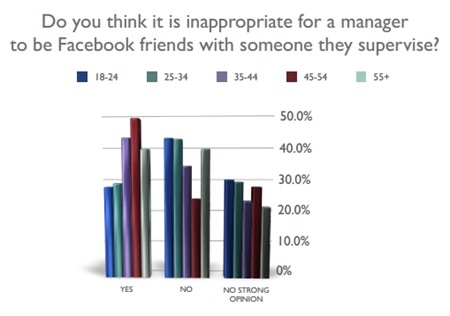
ZDNet’s Friending Facebook blog reports on a survey [pdf] conducted by marketing agency Russell Herder, which concluded that 21% of employees are Facebook friends with the boss. I’ve written before about some of the risks, and some of the benefits, that germinate from taking workplace relationships online into the social sphere. Those issues haven’t changed.

There’s a lot of interesting data in the report. At 9 pages, it’s definitely worth your reading time. The data that I found to be the most interesting deals with the impact of an employee’s age on the opinion of online relationships between managers and employees:

Only 28% of employees ages 18-34 believe it is inappropriate to friend their supervisor on Facebook. The number rises to nearly 50% for those ages 45 and up.

These numbers confirm what I’ve long believed—that generational differences in attitudes about the role of technology in our daily lives exponentially complicates employers’ ability to regulate the use of social media in the workplace. To effectively implement a social media policy in your organization, you will have to account for (and solve) this generational divide.

Wednesday, February 15, 2012

What is an employee’s word for the need for FMLA leave worth? Not much


How often does this scenario play out in your organization? An employee tells a supervisor that he’s sick and needs to take FMLA leave. The supervisor refers the issue to HR or management. Paralyzed out of fear that they will screw up an FMLA process that they really doesn’t understand, they approve the FMLA leave with no other questions asked.

Because of a fundamental misunderstanding of when employees qualify for FMLA leave, lots of employers over-compensate when dealing with employee medical issues and the FMLA. They over-compensate by mistakenly assuming that any employee with any illness or medical condition is FMLA-eligible. In reality, only an employee with a “serious medical condition” qualifies for FMLA-leave.

In reality, you do not have to take an employee at his or her word that he or she needs FMLA leave. Case in point? Huberty v.Time Warner Entertainment Co. (N.D. Ohio 2/8/12).

Huberty claimed that Time Warner interfered with his rights under the FMLA when it fired him after he asked his supervisor for time off to deal with “stress in his life.” Before Huberty found a doctor to certify his medical condition, he began taking time off. Time Warner terminated Huberty for violating its no-call/no-show policy for three consecutive days.

The court dismissed Huberty’s FMLA claim, concluding that neither his own subjective assessment of his health did not satisfy his burden to establish a “serious health condition.”

There is an abundance of case law that makes it clear that Huberty’s own subjective assessment of his health cannot be used to demonstrate a serious health condition. A colleague on this Court has noted as follows with respect to this burden:

It does not mean that, in the employee’s own judgment, he or she should not work, or even that it was uncomfortable or inconvenient for the employee to have to work. Rather, it means that a “health care provider” has determined that, in his or her professional medical judgment, the employee cannot work (or could not have worked) because of the illness. If it were otherwise, a note from a spouse, parent, or even one’s own claim that one cannot work because of illness would suffice. Given the legislative history surrounding its enactment, the FMLA cannot be understood to establish such liberal standards for its application.

What does this mean for your management of your employees’ FMLA leave? Don’t just take your employees at their word that they need FMLA leave. You have an absolute right to request and receive a timely medical certification before certifying a leave of absence as FMLA-qualifying. Do not short-circuit your rights by rubber-stamping every employee medical request as “FMLA.”

Tuesday, February 14, 2012

Nothing can go wrong when employees date each other, right?


In honor of Valentine’s Day, I bring you a story of love, romance … and sexual harassment (what else?).

Sanders v. DaimlerChrysler Corp. starts out like any great love story. Girl meets boy on the assembly line of the local automobile plant. They date for two years. Then, she tells him she doesn’t want to continue their relationship. How does boy respond? Like any alleged harasser, he says, “I can do something to your job.” And, she takes him at his word (he’s a union steward after all). When she has job-related issues returning from a medical leave, she sues the company for, among other things, sexual harassment. Ultimately, this story ended well for the employer; it won the case at trial. But, it cost the company seven years of litigation, more than a dozen depositions, countless motion practice, a costly trial, and a trip to the court of appeals.

I’m not here to tell you that you should forbid your employees from dating. Far from it. The heart is going to go where the heart wants to go. In other words, if your employees want to date, they will — with or without a policy forbidding their relationships and dalliances. Instead, look at workplace romances as an opportunity to educate your employees about the ins and outs of your harassment policy. Train your employees about what is and is not appropriate workplace conduct between the sexes. Focusing on conduct (and misconduct) instead of the relationships will provide your employees the necessary tools to avoid the types of problems that arose in Sanders, which, in turn, will help your organization avoid the litigation expenses those problems often cause.

Happy Valentine’s Day

[Link]

Monday, February 13, 2012

Let’s try not to over-react to the breastfeeding discrimination case


Last month, I wrote that employers denying lactation rights to employees was not problem that needed remedial legislation. Wouldn’t you know it, news broke last week of a federal judge in Houston who dismissed a sex discrimination case—EEOC v. Houston Funding [pdf]—in which the employee alleged that she was fired because she asked to pump breast milk at work.

Here’s the court’s entire analysis dismissing the lawsuit:

The commission says that the company fired her because she wanted to pump breast milk. Discrimination because of pregnancy, childbirth, or a related medical condition is illegal….

Even if the company’s claim that she was fired for abandonment is meant to hide the real reason — she wanted to pump breast milk — lactation is not pregnancy, childbirth, or a related medical condition.

She gave birth on December 11, 2008. After that day, she was no longer pregnant, and her pregnancy-related conditions had ended. Firing someone because of lactation or breast-pumping is not sex discrimination.

Before I put on my employer-advocate hat, let me go on record and say that the last I checked, women are the only gender that can naturally produce milk, and therefore denying a woman the right to lactate is sex discrimination.

This decision has people angry. As of this morning, the case’s online docket reflects that 12 private non-parties have emailed the judge calling her ruling “shameful” and “absurd” (among other similar pejoratives).

Before people over-react and scream from the rooftops for remedial legislation to clarify that lactation discrimination equates to sex discrimination, one case does not make a rule. In fact, it is much more likely that one case is merely an aberration. I stand by my conviction that 1) Title VII’s prohibitions against sex and pregnancy discrimination adequately cover the rights of working moms to lactate; and 2) we do not need any additional legislation (on top of the Patient Protection and Affordable Care Act) to further to protect this right (EEOC v. Houston Funding notwithstanding).

For additional analysis of this case, I suggest checking out the thoughts of some of my fellow bloggers from last week:

Friday, February 10, 2012

WIRTW #212 (the “something for nothing” edition)


One of the benefits of hitting the road to speak as much as I do is all of the great people I meet. One of those people is Jessica Miller-Merrell, who authors the fabulous HR blog, Blogging4Jobs. On February 21 I, along with Mike VanDervort (author of The Human Race Horses) will guest on a free webinar Jessica is presenting, Understanding Unions, NLRB, & Corporate Social Media:

This session provides a broad overview for senior business leaders (and not just HR) regarding the recent legislation surrounding social media, the NLRB, and strategies for how company leaders can maneuver and monitor employee activity on social networking sites. Learn best practices how to manage and discipline your employees, create policies, and awareness throughout your organization.  

I’ll be addressing the NLRB’s latest attempts to regulate employer restrictions on employees’ use of social media, in and out of the workplace. The webinar will run from 12:00 to 1:30 pm on February 21, and registration is free.

m2nvgzm2

Here’s the rest of what I read this week:

Discrimination

Social Media & Workplace Technology

HR & Employee Relations

Wage & Hour

Labor Relations

Thursday, February 9, 2012

What isn’t a “complaint” under the FLSA? An Ohio federal court weights in


In Kasten v. Saint-Gobain Performance Plastics, the United States Supreme Court concluded that the anti-retaliation provision of the Fair Labor Standards Act covers oral complaints — but only if they are “sufficiently clear and detailed for a reasonable employer to understand it, in light of both content and context, as an assertion of rights protected by the statute and a call for their protection.” The issue of what qualifies as a “clear and detailed … assertion of rights” was front and center in Riffle v. Wal-Mart Stores, Inc. (N.D. Ohio 1/24/12).

In Riffle, the only complaints the plaintiff made to her Wal-Mart supervisors were complaints about receiving telephone calls she received at home from co-workers who needed assistance in the cash office. The court concluded that the complaints did not satisfy the threshold established in Kasten.

Plaintiff’s complaints … are insufficient because they are not framed in terms of an FLSA violation as required by Kasten. The complaints plaintiff testified she made to her supervisors could not have reasonably been perceived by defendants as a complaint that plaintiff was not being paid in accordance with the requirements of the FLSA or that defendants otherwise violated the FLSA.

Following Riffle, employers have some guidance as to the types of communications that do not qualify for protection under the FLSA’s anti-retaliation provision. Figuring out what does qualify will prove trickier, and will take years of cases and judicial opinions to sort out.

In the meantime, try not to do the following to your employees who engage in some protected activity:

[Link to YouTube video for those reading in an email]

Wednesday, February 8, 2012

Another consideration in the high cost of wage and hour litigation: e-discovery


I’ve written before about the high risks companies face from wage and hour class/collective lawsuits (here’s one example). Here’s another factor to consider: the exorbitant costs imposed by e-discovery and employers’ obligations to preserve electronic records.

Workplace Prof Blog brings us the story of Pippins v. KPMG, a wage and hour collective action alleging that the accounting firm deprived its Audit Associates of overtime wages. Before the class was even certified, the court imposed upon KPGM the obligation to preserve the potential class members’ more-than 2,500 laptop hard drives. Following certification, KPMG argued that instead of preserving all of the hard drives—at an astounding cost of more than $1.5 million—it should only be required to keep a representative sample comprised of the named plaintiffs.

The court disagreed:

Based on Plaintiff’s recollections regarding their former hard drives, I agree with [Magistrate] Judge Cott that the hard drives are likely to contain relevant information. The information on the hard drives will likely demonstrate when the Audit Associates were working (hours) and what they did while at work (duties). This information is obviously relevant in a case asserting violations of the FLSA … since Plaintiffs need to establish what type of work they performed in order to prevail on the merits, and how many hours a week they worked in order to collect damages….

I gather that KPMG takes the position that the only Audit Associates who are presently “parties” are the named plaintiffs, and so only the named plaintiffs’ hard drives really need to be preserved. But that is nonsense…. [T]he duty to preserve all relevant information for “key players” is triggered when a party “reasonably anticipates litigation.” At the present moment, KPMG should “reasonably anticipate” that every Audit Associate who will be receiving opt-in notice is a potential plaintiff in this action.

What are the lessons for employers?

  1. When considering the goofy costs (and risks) of wage and hour non-compliance, you not only have to factor in unpaid wages, liquidated damages, your legal fees, and the employees’ legal fees, but also the costs of preserving all of the electronic information the plaintiffs will seek in discovery. Like most employment cases, there exists a palpable disparity in the ownership of information. Employers possess most of the relevant information, and therefore carry most of the costs in the retention and production of documents. 
  2. To guard against these goofy costs, audit your wage and hour practices. ’Tis better to spend a few thousand dollars up front to gain knowledge of which of the myriad wage and hour laws your company might be violating, than to spend a few hundred thousand (or a few million!) dollars later to defend against, or pay out on, a wage and hour class action. (Not that employers can't win these cases).

Tuesday, February 7, 2012

The digital divide and disparate impact


According to statistics recently published by Mashable, the digital divide—those who are connected to the Internet versus those who are not—is partially racial. 72% of white homes are connected to the Internet, as compared to only 57% of Hispanic homes and 55% of African American homes.

These numbers mean that if you are using access to technology as a qualifying factor for employment, your hiring practices might have a disparate impact on Hispanics and African Americans. For example, do you only accept job application over the Internet? Or, do you only recruit via Monster.com or LinkedIn? Or do you only consider candidates whom you can vet via Facebook or some other digital footprint? If so, you might want to consider casting a wider net, unless remote technology access is truly job related and consistent with business necessity.