Tuesday, July 31, 2012

“Bitch” as sexual harassment: context matters (sort of)


Bitch (n): 1) A lewd or immoral woman; or 2) a malicious, spiteful, or overbearing woman—sometimes used as a generalized term of abuse.
Merriam-Webster Online Dictionary

According to a recent survey, half of all employees swear on the job. Passananti v. Cook County (7th Cir. 7/20/12) answers the question of whether there exists a line between swearing as workplace banter and swearing as unlawful harassment.

After losing her job as a deputy director with the Cook County Sheriff’s Department, Kimberly Passananti sued, claiming that her director had subjected her to sexual harassment by calling her a “bitch” on “numerous occasions” over a “progressive period of time.” A jury awarded Passananti $4.2 million in damages, of which $70,000 was compensation for the sexual harassment. The trial court set aside the entire verdict. The 7th Circuit reinstated the verdict on the sexual harassment claim.

The Court started its analysis of whether the use of the word “bitch” constitutes sex-based harassment by dismissing any argument that its common use has neutered the word:

We recognize that the use of the word “bitch” has become all too common in American society, and its use has permeated many workplaces. Common use, however, has not neutralized the word as a matter of law.

The Court concluded that even though “bitch” is sexually based, its use must be examined in context to determine whether it constitutes harassment “because of sex.”

We do not hold that use of the word “bitch” is harassment “because of sex” always and in every context…. [T]he use of the word in the workplace must be be viewed in context…. But we do reject the idea that a female plaintiff who has been subjected to repeated and hostile use of the word “bitch” must produce evidence beyond the word itself to allow a jury to infer that its use was derogatory towards women. The word is gender-specific, and it can reasonably be considered evidence of sexual harassment….

Whether its use is sufficient evidence of actionable sexual harassment is, of course, another matter. As with so many other things, when gender-specific language is used in the workplace, these cases and others recognize that context is key. We must proceed with “[c]ommon sense, and an appropriate sensitivity” to that context to distinguish between general vulgarity and discriminatory conduct or language “which a reasonable person in the plaintiff’s position would find severely hostile or abusive.”

In other words, “bitch” is sufficiently gender-specific such that in most cases a jury should apply its common sense to determine whether the pejorative use of the word towards a female employee constitutes harassment because of sex.

In the day-to-day management of your employees, however, you should not get bogged down in legal minutia whether one employee calling another employee a “bitch” is actionable sexual harassment. If an employee complains that he or she is being called vulgarities or other offensive names, you have only one option—investigate and take appropriate corrective action.

[Hat tip: Judy Greenwald at Workforce]
Monday, July 30, 2012

More on educating your employees about being “profersonal”


Earlier this morning, I wrote about the confluence of our professional and personal personas, and the need for employers to educate employees about the importance of maintaining a proper online image. How do you go about engaging in this education? The U.S. Olympic Women’s Soccer team provides a great example.

Goalie Hope Solo took to Twitter (where else) to criticize media coverage of her team’s defensive play after their 3-0 win Saturday against Colombia.

Instead of disciplining Solo, coach Pia Sundhage sat her down and talked to her about the importance of her online image. Per ESPN:

“We had a conversation: If you look at the women’s national team, what do you want (people) to see? What do you want them to hear?” Sundhage told reporters at the team hotel. "And that’s where we do have a choice—as players, coaches, staff, the way we respond to certain things.”

Thank you Coach Sundhage for providing a perfect epilogue to my post from earlier this morning.

Does your social media policy educate about being “profersonal?”


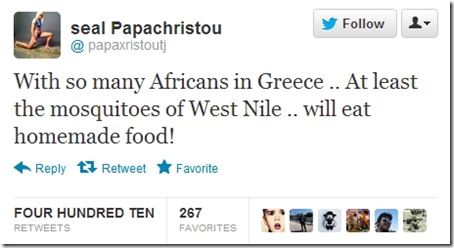
Jason Seiden, the co-founder and CEO of Ajax Social Media, calls it profersonal: the inherent intertwining of our personal and professional personas online. Last week, Greek Olympian Voula Papachristou got a quick and dirty lesson on being profersonal. Greece removed her from its Olympic team over a tweet mocking African immigrants. Here’s the offending tweet:

According to The Huffington Post, the Hellenic Olympic Committee subsequently “banned all Greek athletes from using social media to express any personal opinions not related to the Olympics and to the preparation for their competitions.”

Voula’s story is a perfect illustration of the disappearing line between the professional and the personal online. If an employee doesn’t want something they say online to affect their employment, they shouldn’t post it. We can debate whether an employee should lose his or her job for something non-work-related he or she posts on his or her personal time. If, however, someone can connect an employee to his or her place of employment through an online profile, what is posted becomes fair game for an employment decision.

The takeaway might simply be that employers remind their employees to “be professional” online, and that businesses will hold employees accountable for what they post that could cast the company in a bad light. Amazingly, however, the NLRB might take issue with such a policy.

In his latest missive on workplace social media policies, NLRB Acting General Counsel Lafe Solomon passed judgment on the following neutral provision in an employer’s social media policy:

Remember to communicate in a professional tone…. This includes not only the obvious (no ethnic slurs, personal insults, obscenity, etc.) but also proper consideration of privacy and topics that may be considered objectionable or inflammatory—such as politics and religion.

Mr. Solomon concluded that such a policy, which merely reminds employees “to communicate in a professional tone,” unlawfully restricts employees’ rights to engage in protected concerted activity:

We found this rule unlawful…. [R]eminding employees to communicate in a “professional tone,” the overall thrust of this rule is to caution employees against online discussions that could become heated or controversial. Discussions about working conditions or unionism have the potential to become just as heated or controversial as discussions about politics and religion.

What’s the real lesson here? Social media is an evolving communication tool. Employees have not yet figured out what it means to be “profersonal.” Employees need to realize that anything they say online can impact their professional persona, and that every negative or offensive statement could lead to discipline or termination (even if employers can overreact in these situations). Until people fully understand that social media is erasing (has erased?) the line between the personal and the professional, these issues will continue to arise. It is our job as employers to help educate our employees about living in a “profersonal” world, even at the risk of offending the NLRB’s prickly sensitivities.

Friday, July 27, 2012

WIRTW #235 (the “exciting announcement” edition)


The Employer Bill of Rights remains one of my most popular posts. In fact, it’s so popular it got its own book deal. All joking aside, I am very proud to announce that I have been hard at work on my second book, The Employer Bill of Rights. Since I just received the cover art, I figured now is as good a time as any to break the news. Apress will publish the book by year’s end. I’ll update with links to Amazon and other points-of-sale when they go live (which I’m told will be soon).

=

Here’s the rest of what I read this week:

Discrimination

Social Media & Workplace Technology

HR & Employee Relations

Wage & Hour

Thursday, July 26, 2012

Co-worker complaints about revised schedules may not be enough to create undue hardship for religious accommodation


Four days after the University of Tennessee, Knoxville, hired Kimberly Crider, she informed her supervisor that she was a Seventh Day Adventist, which precluded her from working from sundown Friday through sundown Saturday. Crider’s job responsibilities included monitoring an emergency cell phone on a rotating basis during weekends. When Crider’s co-workers refused to exchange shifts to accommodate her, the university determined she was unable to fulfill her job duties and terminated her. As you would guess, Crider sued, claiming religious discrimination under Title VII.

Title VII requires an employer to reasonably accommodate an employee whose sincerely held religious belief, practice, or observance conflicts with a work requirement, unless doing so would pose an undue hardship. An accommodation poses an undue hardship if it causes more than de minimis cost on the operation of the employer’s business. In Crider v. University of Tennessee, Knoxville (6th Cir. 7/23/12) [pdf], the 6th Circuit applied these principles and concluded that a jury should decide whether the university lawfully refused to force its employees to change shifts to accommodate a co-worker’s religion.

UTK insists that requiring its employees to work Saturday shifts every other weekend would have created an undue hardship for Crider’s former co-workers…. UTK … insist[s] that a significant effect on a co-worker will suffice to establish an undue hardship…. Title VII does not exempt accommodation which creates undue hardship on the employees; it requires reasonable accommodation “without undue hardship on the conduct of the employer’s business.”

The Court concluded that “employee dissatisfaction or inconvenience alone” does not create an undue hardship. Instead, “it is the effect such dissatisfaction has on the employer’s ability to operate its business that may alleviate the duty to accommodate.”

According to the EEOC, “It would pose an undue hardship to require employees involuntarily to substitute for one another or swap shifts.” Some might argue that this case undercuts the EEOC’s position. In reality, I think that the employer simply failed to prove the undue hardship with actual facts and data relative to its operations.

If you are planning on rejecting an employee’s request for a shift change as a religious accommodation, you must be able to support the claim of hardship with facts.

  • How does it impact your scheduling?
  • Do you have to hire additional staffing to cover for the missed shifts?
  • How much would it cost you in added overtime or other premium wages?
  • How often would you have to pay overtime or other premium wages?

Without providing answers to these questions, you will be hard-pressed to prove that a shift swap creates an undue hardship.

Wednesday, July 25, 2012

FMLA guarantee of reinstatement is never absolute


When an employee returns from FMLA leave, that employee is entitled to be reinstated to the same or equivalent position he or she held prior to the leave. As Winterhalter v. Dykhuis Farms (6th Cir. 7/23/12) [pdf] illustrates, however, that right to reinstatement is never guaranteed. 

Dykhuis Farms terminated Winterhalter’s employment on the day that Winterhalter was scheduled to return from FMLA leave, allegedly due to economic hardship and Winterhalter’s status as the highest-paid and lowest-performing of the workers in his unit. The court concluded that despite the fact that he was fired on the day he returned from leave, his employer neither retaliated against her nor interfered with her job restoration rights under the statute. The farm came forward with well-documented evidence that its economic hardship and its need to take "drastic measures to improve its financial performance,” motivated the termination, not Winterhalter's FMLA leave.

As the 6th Circuit correctly pointed out, the FMLA's reinstatement "provisions do not create a greater right to reinstatement or protection against termination than the employee would receive if he had not taken FMLA leave. Therefore, an employer may dismiss an employee who has taken FMLA leave, but only if the employer has a legitimate reason unrelated to the exercise of FMLA rights for engaging in the challenged conduct.”

Notifying an employee of a termination the day he or she returns from FMLA leave is a risky proposition. It will likely draw a lawsuit. The key to winning the lawsuit is having a legitimate and documented reason to support the termination. In this case, it was economic hardship. In others, it could be the discovery of serious performance deficiencies. Despite the FMLA's job restoration guarantee, you can terminate an employee who is out on an FMLA leave. You just have a really good reason, and you have to be able to back it up.


Tuesday, July 24, 2012

Don’t estop believing: employer backs itself into FMLA claim for ineligible employee


I’ve written before about the FMLA’s unique rules for when an employer is covered and when an employee becomes eligible to take leave.

  • The FMLA covers any private employer that has 50 or more employees on the payroll during 20 or more calendar workweeks in either the current or the preceding calendar year.
  • An employee becomes eligible to take leave under the FMLA once the employee has worked for at least 12 non-consecutive months, worked 1,250 hours during the prior 12 month period, and works at a location where the employer has 50 or more employees within a 75-mile radius.

What happens, however, if a non-covered employer mistakenly grants FMLA leave to an employee, or if a covered employer mistaken grants FMLA to an ineligible employee? If the employer catches its mistake and fires the employee for taking unexcused absences, can the employee sue for retaliation under the FMLA? According to the court in Medley v. County of Montgomery (E.D. Pa. 7/16/12), the answer is yes.

Medley requested intermittent leave because of her son’s serious health conditions. Even though she had worked less than 1,250 hours during the prior 12 months, county officials told her that she qualified for FMLA leave and provided her with various FMLA forms. Once she started taking the intermittent leave, however, the county began to write her up. Within days, the county fired her for taking unauthorized leaves.

The court concluded that Medley could pursue her FMLA retaliation claim under an estoppel theory:

“The doctrine of equitable estoppel is used to prevent ‘one party from taking unfair advantage of another when, through false language or conduct, the person to be estopped has induced another person to act in a certain way, with the result that the other person has been injured in some way.’” …

In the context of the FMLA, “equitable estoppel may, in an appropriate factual scenario, provide a means of redress for employees who detrimentally rely on their employers' misrepresentations about FMLA eligibility.” … “[A]n employer who without intent to deceive makes a definite but erroneous representation to his employee that she is an ‘eligible employee’ and entitled to leave under the FMLA, and has reason to believe that the employee will rely upon it, may be estopped to assert a defense of non-coverage” if the employee reasonably relied on the misrepresentation to her detriment.

This case underscores the importance of training those who manage your FMLA program on the law’s special coverage and eligibility requirements. These employees must intrinsically understand the numerical thresholds and how to apply them. As the Medley case illustrates, you could be bound to mistakes (computational or otherwise), which could prove costly.

[Hat tip: Employment Law Matters]