Monday, February 20, 2012

8 things you need to know about holiday pay


Today is Presidents’ Day. According to a recent poll of employers conducted by SHRM, 34% of employers will be closed today. Whether you are closed on any holiday, here are 8 things you should know about holiday pay for your employees. All of these guidelines assume that your company lacks a collective bargaining agreement.

1. Do you have to pay for holidays? You are not required to pay non-exempt employees for holidays. Paid holidays is a discretionary benefit left entirely up to you. Exempt employees present a different challenge. The Fair Labor Standards Act does not permit employers to dock the salary of an exempt employee for holidays. You can make a holiday unpaid for exempt employees, but it will jeopardize their exempt status, at least for that week.

2. What happens if holiday falls on an employee’s regularly scheduled day off, or when the business is closed? While not required, many employers give an employee the option of taking off another day if a holiday falls on an employee’s regular day off. This often happens when employees work compressed schedules (four 10-hour days as compared to five 8-hour days). Similarly, many employers observe a holiday on the preceding Friday or the following Monday when a holiday falls on a Saturday or Sunday when the employer is not ordinarily open.

3. If we choose to pay non-exempt employees for holidays, can we require that they serve some introductory period to qualify? It is entirely up to your company’s policy whether non-exempt employees qualify for holiday pay immediately upon hire, or after serving some introductory period. Similarly, an employer can choose only to provide holiday pay to full-time employees, but not part-time or temporary employees.

4. Can we require employees to work on holidays? Because holiday closings are a discretionary benefit, you can require that employees work on a holiday. In fact, the operational needs of some businesses will require that some employees work on holidays (hospitals, for example).

5. Can we place conditions on the receipt of holiday pay? Yes. For example, some employers are concerned that employees will combine a paid holiday with other paid time off to create extended vacations. To guard again this situation, some companies require employees to work the day before and after a paid holiday to be eligible to receive holiday pay.

6. How do paid holidays interact with the overtime rules for non-exempt employees? If an employer provides paid holidays, it does not have to count the paid hours as hours worked for purposes of determining whether an employee is entitled to overtime compensation. Also, an employer does not have to pay any overtime or other premium rates for holidays (although some choose to do so).

7. Do you have to provide holiday pay for employees on FMLA leave? You have to treat FMLA leaves of absence the same as other non-FMLA leaves. Thus, you only have to pay an employee for holidays during an unpaid FMLA leave if you have a policy of providing holiday pay for employees on other types of unpaid leaves. Similarly, if an employee reduces his or her work schedule for intermittent FMLA leave, you may proportionately reduce any holiday pay (as long as you treat other non-FMLA leaves the same).

8. If an employee takes a day off as a religious accommodation, does it have to be paid? An employer must reasonably accommodate an employee whose sincerely held religious belief, practice, or observance conflicts with a work requirement, unless doing so would pose an undue hardship. One example of a reasonable accommodation is unpaid time off for a religious holiday or observance. Another is allowing an employee to use a vacation day for the observance.

Here comes the disclaimer. The laws of your state might be different. If you are considering adopting or changing a holiday pay policy in your organization, or have questions about how your employees are being paid for holidays and other days off, it is wise to consult with counsel.
Friday, February 17, 2012

WIRTW #213 (the “Hello Cleveland!” edition)


Above the Law (c/o the Chicago Sun-Times) reports that Justice Scalia offered the following words of wisdom while speaking to a group of students at the University of Chicago School of Law:

Try to find a practice that enables you to maintain a human existence … time for your family, your church or synagogue, community … boy scouts, little league…. You should look for a place like that. I’m sure they’re still out there. Maybe you have to go to Cleveland.

Readers, introducing the next spokesperson for Positively Cleveland, United States Supreme Court Justice Antonin Scalia.

Here’s the rest of what I read this week:

Discrimination

Social Media & Workplace Technology

HR & Employee Relations

Wage & Hour

Until next week:

Thursday, February 16, 2012

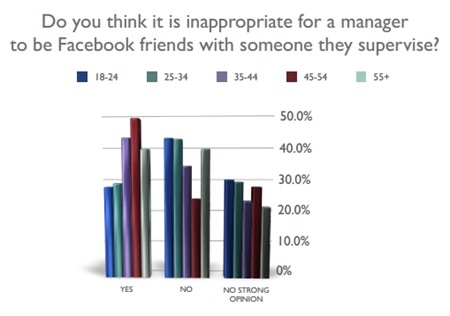
Latest stats about supervisors being “Facebook friends” with employees reveals interesting generational data


ZDNet’s Friending Facebook blog reports on a survey [pdf] conducted by marketing agency Russell Herder, which concluded that 21% of employees are Facebook friends with the boss. I’ve written before about some of the risks, and some of the benefits, that germinate from taking workplace relationships online into the social sphere. Those issues haven’t changed.

There’s a lot of interesting data in the report. At 9 pages, it’s definitely worth your reading time. The data that I found to be the most interesting deals with the impact of an employee’s age on the opinion of online relationships between managers and employees:

Only 28% of employees ages 18-34 believe it is inappropriate to friend their supervisor on Facebook. The number rises to nearly 50% for those ages 45 and up.

These numbers confirm what I’ve long believed—that generational differences in attitudes about the role of technology in our daily lives exponentially complicates employers’ ability to regulate the use of social media in the workplace. To effectively implement a social media policy in your organization, you will have to account for (and solve) this generational divide.

Wednesday, February 15, 2012

What is an employee’s word for the need for FMLA leave worth? Not much


How often does this scenario play out in your organization? An employee tells a supervisor that he’s sick and needs to take FMLA leave. The supervisor refers the issue to HR or management. Paralyzed out of fear that they will screw up an FMLA process that they really doesn’t understand, they approve the FMLA leave with no other questions asked.

Because of a fundamental misunderstanding of when employees qualify for FMLA leave, lots of employers over-compensate when dealing with employee medical issues and the FMLA. They over-compensate by mistakenly assuming that any employee with any illness or medical condition is FMLA-eligible. In reality, only an employee with a “serious medical condition” qualifies for FMLA-leave.

In reality, you do not have to take an employee at his or her word that he or she needs FMLA leave. Case in point? Huberty v.Time Warner Entertainment Co. (N.D. Ohio 2/8/12).

Huberty claimed that Time Warner interfered with his rights under the FMLA when it fired him after he asked his supervisor for time off to deal with “stress in his life.” Before Huberty found a doctor to certify his medical condition, he began taking time off. Time Warner terminated Huberty for violating its no-call/no-show policy for three consecutive days.

The court dismissed Huberty’s FMLA claim, concluding that neither his own subjective assessment of his health did not satisfy his burden to establish a “serious health condition.”

There is an abundance of case law that makes it clear that Huberty’s own subjective assessment of his health cannot be used to demonstrate a serious health condition. A colleague on this Court has noted as follows with respect to this burden:

It does not mean that, in the employee’s own judgment, he or she should not work, or even that it was uncomfortable or inconvenient for the employee to have to work. Rather, it means that a “health care provider” has determined that, in his or her professional medical judgment, the employee cannot work (or could not have worked) because of the illness. If it were otherwise, a note from a spouse, parent, or even one’s own claim that one cannot work because of illness would suffice. Given the legislative history surrounding its enactment, the FMLA cannot be understood to establish such liberal standards for its application.

What does this mean for your management of your employees’ FMLA leave? Don’t just take your employees at their word that they need FMLA leave. You have an absolute right to request and receive a timely medical certification before certifying a leave of absence as FMLA-qualifying. Do not short-circuit your rights by rubber-stamping every employee medical request as “FMLA.”

Tuesday, February 14, 2012

Nothing can go wrong when employees date each other, right?


In honor of Valentine’s Day, I bring you a story of love, romance … and sexual harassment (what else?).

Sanders v. DaimlerChrysler Corp. starts out like any great love story. Girl meets boy on the assembly line of the local automobile plant. They date for two years. Then, she tells him she doesn’t want to continue their relationship. How does boy respond? Like any alleged harasser, he says, “I can do something to your job.” And, she takes him at his word (he’s a union steward after all). When she has job-related issues returning from a medical leave, she sues the company for, among other things, sexual harassment. Ultimately, this story ended well for the employer; it won the case at trial. But, it cost the company seven years of litigation, more than a dozen depositions, countless motion practice, a costly trial, and a trip to the court of appeals.

I’m not here to tell you that you should forbid your employees from dating. Far from it. The heart is going to go where the heart wants to go. In other words, if your employees want to date, they will — with or without a policy forbidding their relationships and dalliances. Instead, look at workplace romances as an opportunity to educate your employees about the ins and outs of your harassment policy. Train your employees about what is and is not appropriate workplace conduct between the sexes. Focusing on conduct (and misconduct) instead of the relationships will provide your employees the necessary tools to avoid the types of problems that arose in Sanders, which, in turn, will help your organization avoid the litigation expenses those problems often cause.

Happy Valentine’s Day

[Link]

Monday, February 13, 2012

Let’s try not to over-react to the breastfeeding discrimination case


Last month, I wrote that employers denying lactation rights to employees was not problem that needed remedial legislation. Wouldn’t you know it, news broke last week of a federal judge in Houston who dismissed a sex discrimination case—EEOC v. Houston Funding [pdf]—in which the employee alleged that she was fired because she asked to pump breast milk at work.

Here’s the court’s entire analysis dismissing the lawsuit:

The commission says that the company fired her because she wanted to pump breast milk. Discrimination because of pregnancy, childbirth, or a related medical condition is illegal….

Even if the company’s claim that she was fired for abandonment is meant to hide the real reason — she wanted to pump breast milk — lactation is not pregnancy, childbirth, or a related medical condition.

She gave birth on December 11, 2008. After that day, she was no longer pregnant, and her pregnancy-related conditions had ended. Firing someone because of lactation or breast-pumping is not sex discrimination.

Before I put on my employer-advocate hat, let me go on record and say that the last I checked, women are the only gender that can naturally produce milk, and therefore denying a woman the right to lactate is sex discrimination.

This decision has people angry. As of this morning, the case’s online docket reflects that 12 private non-parties have emailed the judge calling her ruling “shameful” and “absurd” (among other similar pejoratives).

Before people over-react and scream from the rooftops for remedial legislation to clarify that lactation discrimination equates to sex discrimination, one case does not make a rule. In fact, it is much more likely that one case is merely an aberration. I stand by my conviction that 1) Title VII’s prohibitions against sex and pregnancy discrimination adequately cover the rights of working moms to lactate; and 2) we do not need any additional legislation (on top of the Patient Protection and Affordable Care Act) to further to protect this right (EEOC v. Houston Funding notwithstanding).

For additional analysis of this case, I suggest checking out the thoughts of some of my fellow bloggers from last week:

Friday, February 10, 2012

WIRTW #212 (the “something for nothing” edition)


One of the benefits of hitting the road to speak as much as I do is all of the great people I meet. One of those people is Jessica Miller-Merrell, who authors the fabulous HR blog, Blogging4Jobs. On February 21 I, along with Mike VanDervort (author of The Human Race Horses) will guest on a free webinar Jessica is presenting, Understanding Unions, NLRB, & Corporate Social Media:

This session provides a broad overview for senior business leaders (and not just HR) regarding the recent legislation surrounding social media, the NLRB, and strategies for how company leaders can maneuver and monitor employee activity on social networking sites. Learn best practices how to manage and discipline your employees, create policies, and awareness throughout your organization.  

I’ll be addressing the NLRB’s latest attempts to regulate employer restrictions on employees’ use of social media, in and out of the workplace. The webinar will run from 12:00 to 1:30 pm on February 21, and registration is free.

m2nvgzm2

Here’s the rest of what I read this week:

Discrimination

Social Media & Workplace Technology

HR & Employee Relations

Wage & Hour

Labor Relations